Backstage Post: Anatomy of a Poem
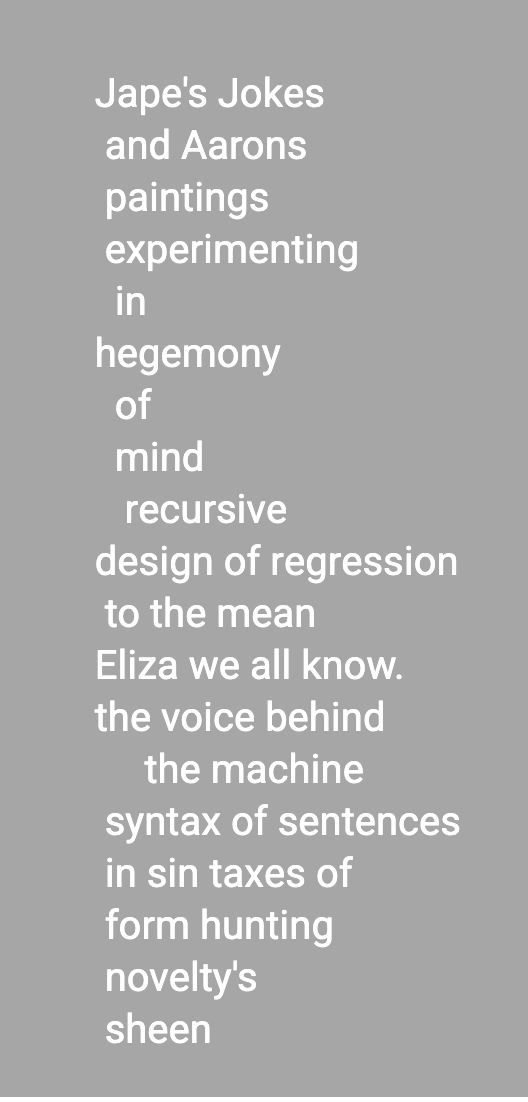
Writing a poetic response to the readings provides interesting opportunities to integrate learning. Found poems or broken metaphors, playing with meaning increases deeper understanding.
This week in EDU 106 we focused on recognizing the text structure of quantitative research as we considered learning, large language models and Creativity. We considered creativity in microfiction in Doshi and Hauser’s “Generative AI enhances individual creativity but reduces the collective diversity of novel content” and learning in Bastani, Bastani, and Sungus “Generative AI without guardrails can harm learning: Evidence from high school mathematics”
To respond by poetry I began to dig deeper, and read Bowden’s 1988 piece on Creativity and Artifical Intelligence. Adding a source beyond your assignments material is a really easy hack for college writing. Professors love that stuff.
From this piece I lifted the name of AI software in early creativity experiments, Japes, Aaron, and Bacon. Then as a callback to the microfiction piece I illustrate the claim of how the AI assisted microfiction had less divergent than the human only crafted narrative,
We also explored the limits of expertise. The more divergent writers didn’t gain much assistance with AI. Now this was just 8 sentence microfiction? Would AI assisted novel writing produce similar results. In the math classroom unaided AI inflated performance and without guardrails lead to extreme learning decay (or more likely inflation in the first measure). In the story of writing I make reference to regression to mean. Artificial Intelligence is a mathematical prediction, large language models crafting a puzzle with no comprehension of the picture. The developers chase creativity. AN LLM that can produce something novel, while the artisans and teachers worry a lack of friction leads to less expertise.
I also make reference to Eliza, Wisenbaum’s first chatbot that we discussed in class. A little bit of word play makes you question what I mean